Wednesday, January 29, 2014

New government website for Cattle Raising information


www.balinkbayan.gov.ph

BaLinkBayan is a one-stop online portal dedicated to the overseas Filipino. With the steady inflow of remittances to the Philippines and the growing awareness of its potential for sustenance and development, the Commission on Filipinos Overseas (CFO) recognized the need to establish BaLinkBayan. A quip on the Filipino word balikbayan (a returning overseas Filipino), Balinkbayan is a means to connect Filipino individuals and communities to the Philippines through the Diaspora to Development (D2D) program of the CFO. This program promotes and supports diaspora-driven initiatives such as investment, philanthropy, and technology and skills transfer.

 The Cattle Raising page has a profile and Types of Cattle Raising information and other pages which still has to be populated with data.

It also contains tab pages on a per region basis of cattle price trends and contact informatiion for Technical assistance, Financing Institutions and related organizations. 

Generally this is a good site if it has all the information.

Monday, September 9, 2013

Livestock Production Report January to June 2013

Agriculture grew by 1.44 percent in the first half of 2013. Output increments from the livestock, poultry and fisheries subsectors contributed to the overall production gain during the period. The crops subsector suffered a contraction. At current prices, gross earnings in agriculture amounted to P697.2 billion, higher by 0.88 percent than last year's record

The crops subsector which shared 51.79 percent in total agricultural output recorded a 0.54 percent decline. Palay output grew by 1.34 percent. Corn, coconut, sugarcane and banana came down with lower production during the period. The subsector grossed P375.1 billion at current prices. This was 4.30 percent lower than last year's performance.


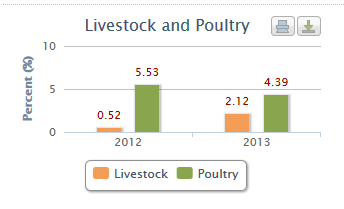
Livestock production increased by 2.12 percent. The subsector contributed 15.53 percent to total agricultural production. Production increases were noted for hog at 2.36 percent and cattle at 2.28 percent. At current prices, the subsector grossed P111.8 billion, up by 11.43 percent from last year's earnings.

The poultry subsector accounted for 14.58 percent of the total agricultural production. It registered 4.39 percent growth in output. Chicken production which increased by 5.05 percent was the main source of growth. The subsector grossed P86.4 billion at current prices. This was 6.25 percent higher from last year's earnings.

On the average, farmgate prices went down by 0.56 percent in the first half of 2013. The crops subsector posted an average price decline of 3.78 percent. Prices in the livestock subsector increased by an average of 9.12 percent. Poultry subsector had a 1.78 percent price gain this year. In the fisheries subsector, prices inched up by an average of 0.94 percent.

Thursday, August 22, 2013

Cattle Project for OFWs


A novel investment scheme for a cow-calf operation designed especially for overseas Filipino workers (OFWs) is being offered by King Ranch, a successful beef cattle breeding and fattening operation in Batangas which is expanding to a 10,000-hectare farm in Palawan.

King Carlos, who is managing the ranch together with his father Alex, says that the project was particularly crafted for returning overseas workers, many of whom are being returning home because of growing political tensions in the Middle East and elsewhere.

He cited the political tensions in Egypt as well as in Syria which are displacing many of the workers there, forcing them to return to the Philippines without assurance of a well-paying job. The other development that is causing serious concern is the Saudization in Saudi Arabia. More

Saturday, September 1, 2012

Triple J Manufacturing

September 2, 2012


With the ongoing  internal management issue with Triple J Manufacturing, it is advisable not to do any transaction with them at the moment. As a cattle raiser I have inquired and even have plans of ordering their products.

Hopefully things can be sorted out and things would go back to business as usual.


Friday, August 10, 2012

How do you classify your cattle?

Basing on physical appearance this will be  some sort of a guide on how to classify the quality of your cattle
Severely emaciated; starving and weak; no palpable fat detectable over backbone or ribs; tailhead and individual ribs prominently visible. Normal production systems cannot maintain cattle in this condition


Emaciated; but not weakened; visible muscle tissue atrophy particularly in hindquarters; backbone, tailhead and ribs prominently visible


Very thin; no fat over ribs or in brisket; backbone sharp and easily visible, slight muscle atrophy


Borderline; individual ribs noticeable but overall fat cover is lacking; increased musculature through shoulders and hindquarters; hips and backbone slightly rounded versus sharp appearance.


Moderate; increased fat cover over ribs, generally only 12th and 13th ribs are individually distinguishable; tailhead full, but not rounded.


Good; back, ribs and tailhead slightly rounded; slight fat deposition beginning to appear in brisket.


Fat; cow appears fleshy and carries fat over the back, tailhead and brisket; ribs are not visible; area around vulva, rectum and udder contain moderate fat deposits.


Very fat; squared appearance due to excess fat over back, tailhead, and hindquarters; extreme fat deposition in brisket over ribs, around vulva, rectum and within udder.


Obese; similar to very fat, but to a greater degree; majority of fat deposited in udder limits effective lactation. Under normal production systems cattle in this condition score are rare.

Now which cattle are you?

Pictures and text courtesy of Crystalyx

Thursday, August 9, 2012

Philippines: islands of opportunities

Even with the current situation right now in which the country is being flooded specially in Metro Manila area due to monsoon rains - still the country's economy is doing well.


A BOOMING economy and growing middle class provide fertile ground for increasing beef and lamb exports to the Philippines.
The Philippines has developed rapidly in recent years, and is projected to become the largest economy in South-East Asia - and 16th largest in the world - by 2050.

Australian beef exports have grown five-fold to the island nation since 2005. In 2011, Australia’s beef exports to the Philippines totalled 19,800 tonnes swt, while lamb exports were 411 tonnes.

Beef consumption is currently estimated at 4kg per head (compared to 34kg in Australia). Local production accounts for 60 per cent of consumption; however, the shortfall from local production continues to grow.

Continue reading

Article courtesy of farmweekly

Sunday, August 5, 2012

Philippine's Agriculture Sector Continues to Grow


The DA said the combined positive performance of the three subsectors served as a cushion, as the fishery subsector registered negative growth due to dwindling fish population caused by overfishing, illegal fishing practices, and successive typhoons during the second semester of 2011.

Total farm production was valued at P1.4 trillion at current prices, 11.5 per cent more than in 2010, it said.

The crops subsector — which contributed one-half or 49.6 per cent to total agricultural output — registered a 4.82 per cent increase, led by palay (paddy rice) and corn.

Likewise, palay harvest totaled 16.68 million metric tons (MMT), 5.8 per cent more than in 2010 (15.77 MMT), while corn production amounted to 6.97 MMT, 9.3 per cent more than in 2010 (6.38 MMT).

Sugarcane production also grew significantly to 28.38 MMT, 58.3 per cent more than in 2010 (17.93 MMT). Tobacco, pineapple and rubber also posted positive gains last year.