Showing posts with label cattle philippines. Show all posts

Wednesday, September 18, 2019

Negros Occidental seeks to increase cattle meat production


BACOLOD CITY -- Negros Occidental is pushing to strengthen the development of the local cattle industry amid the deficiency in the supply of cattle meat in the province.

As part of an initiative to address this concern, the Provincial Veterinary Office (PVO) recently organized a seminar on “Cattle Fattening and Marketing” for the United Cattle Raisers Association in Negros Occidental in partnership with the provincial government and the city government of Sagay.

Dr. Renante Decena, provincial veterinarian, said in a statement on Friday that through the seminar, they want to make the cattle raisers ready towards developing Negros Beef and positioning the province as the center of cattle production in the Visayas. More

Source: Philippine News Agency Article 1070622

Friday, June 13, 2014

Practice: High Efficiency Scraper for Cow Manure

Technical Description

The daily amount of feces and urine produced by a mature cow is about 8% of her body weight. Therefore, in a farm having 100 cows, the annual production of manure will be 2,000 tons per year. If this waste were washed and drained into the rivers and streams, it would not only need a lot of water, but would also cause a big pollution problem. However, the composition of cow manure is quite variable and very useful for the improvement of soil quality. The device designed here collects manure in a waterless and highly efficient way.

Uses and Merits

Overuse of chemical fertilizer will be detrimental to the capacity of the soil. At the same time, the disposal of fairy wastes directly by washing them into the river will result in serious environmental pollution. To collect the dairy wastes by using the devices described above will not only save water but will also ensure a clean farm. The utilization of used tires will reduce the space required for tire disposal. In addition, the undiluted manure will be an excellent source of organic fertilizer for improvement of soil quality.
The device was designed to be connected to a general loader. With a special rubber made from an old truck tire cut to shape, manure can be removed from the concrete floor. The scraper pushes and pulls as the loader moves in a fast and easy way. Also due to the flexibility of athe rubber part, the texture of the floor will not be damaged during manure collection.

Expert's Comments

This device, when used with well-designed manure storage and a spreading area on the farm, will greatly reduce the problem of farm waste. If the rain-drain of the pen is constructed with a separate draining system, the stored manure can be used in a more efficient way. The manure collection will be much more efficient if the runway in the housing area can be constructed with an appropriate width.

Location: Taiwan R.O.C

Livestock Expo 2015 - Better Than Ever!


http://www.livestockphilippines.com/

The Country's Offical Livestock Show Is Back And Better Than Ever!
   
Livestock Philippines 2013 scores another successful show as no less than President Benigno S. Aquino III opened the show to more than 5,000 visitors and 200 exhibitors from 20 countries.

As it runs from August 7 - 9, LIVESTOCK PHILIPPINES 2013 is now one of the springboards in establishing livestock business opportunities not just in the Philippines but throughout Asia.

Visit the site

Monday, September 9, 2013

Livestock Production Report January to June 2013

Agriculture grew by 1.44 percent in the first half of 2013. Output increments from the livestock, poultry and fisheries subsectors contributed to the overall production gain during the period. The crops subsector suffered a contraction. At current prices, gross earnings in agriculture amounted to P697.2 billion, higher by 0.88 percent than last year's record

The crops subsector which shared 51.79 percent in total agricultural output recorded a 0.54 percent decline. Palay output grew by 1.34 percent. Corn, coconut, sugarcane and banana came down with lower production during the period. The subsector grossed P375.1 billion at current prices. This was 4.30 percent lower than last year's performance.


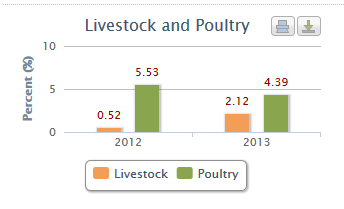
Livestock production increased by 2.12 percent. The subsector contributed 15.53 percent to total agricultural production. Production increases were noted for hog at 2.36 percent and cattle at 2.28 percent. At current prices, the subsector grossed P111.8 billion, up by 11.43 percent from last year's earnings.

The poultry subsector accounted for 14.58 percent of the total agricultural production. It registered 4.39 percent growth in output. Chicken production which increased by 5.05 percent was the main source of growth. The subsector grossed P86.4 billion at current prices. This was 6.25 percent higher from last year's earnings.

On the average, farmgate prices went down by 0.56 percent in the first half of 2013. The crops subsector posted an average price decline of 3.78 percent. Prices in the livestock subsector increased by an average of 9.12 percent. Poultry subsector had a 1.78 percent price gain this year. In the fisheries subsector, prices inched up by an average of 0.94 percent.

Friday, August 10, 2012

How do you classify your cattle?

Basing on physical appearance this will be  some sort of a guide on how to classify the quality of your cattle
Severely emaciated; starving and weak; no palpable fat detectable over backbone or ribs; tailhead and individual ribs prominently visible. Normal production systems cannot maintain cattle in this condition


Emaciated; but not weakened; visible muscle tissue atrophy particularly in hindquarters; backbone, tailhead and ribs prominently visible


Very thin; no fat over ribs or in brisket; backbone sharp and easily visible, slight muscle atrophy


Borderline; individual ribs noticeable but overall fat cover is lacking; increased musculature through shoulders and hindquarters; hips and backbone slightly rounded versus sharp appearance.


Moderate; increased fat cover over ribs, generally only 12th and 13th ribs are individually distinguishable; tailhead full, but not rounded.


Good; back, ribs and tailhead slightly rounded; slight fat deposition beginning to appear in brisket.


Fat; cow appears fleshy and carries fat over the back, tailhead and brisket; ribs are not visible; area around vulva, rectum and udder contain moderate fat deposits.


Very fat; squared appearance due to excess fat over back, tailhead, and hindquarters; extreme fat deposition in brisket over ribs, around vulva, rectum and within udder.


Obese; similar to very fat, but to a greater degree; majority of fat deposited in udder limits effective lactation. Under normal production systems cattle in this condition score are rare.

Now which cattle are you?

Pictures and text courtesy of Crystalyx

Thursday, August 9, 2012

Philippines: islands of opportunities

Even with the current situation right now in which the country is being flooded specially in Metro Manila area due to monsoon rains - still the country's economy is doing well.


A BOOMING economy and growing middle class provide fertile ground for increasing beef and lamb exports to the Philippines.
The Philippines has developed rapidly in recent years, and is projected to become the largest economy in South-East Asia - and 16th largest in the world - by 2050.

Australian beef exports have grown five-fold to the island nation since 2005. In 2011, Australia’s beef exports to the Philippines totalled 19,800 tonnes swt, while lamb exports were 411 tonnes.

Beef consumption is currently estimated at 4kg per head (compared to 34kg in Australia). Local production accounts for 60 per cent of consumption; however, the shortfall from local production continues to grow.

Continue reading

Article courtesy of farmweekly

Tuesday, November 29, 2011

Beef Production Glossary


Agricultural publication G2030 — Reviewed October 1, 1993

Beef Production Glossary

John Massey
Department of Animal Sciences, University of Missouri-Columbia

Accuracy (of selection) — Correlation between an animal's unknown actual breeding value and a calculated estimated breeding value.
Average daily gain (ADG) — Measurement of daily body weight change in animal on a feed test. Most tests for bulls are 140 or 160 days long.
Adjusted weaning weight (WW) — An unshrunk, off-the-cow weight adjusted to 205 days of age and to mature dam age equivalence.
Adjusted yearling weight (YW) — An unshrunk weight adjusted to either 365, 452 or 550 days of age and for age of dam.
Ad lib feeding — No limit placed on amount of feed intake. Self-feeding or allowing cattle to consume feed on a free-choice basis.
Alleles — Alternate forms of genes. Because genes occur in pairs in body cells, one gene of a pair may have one effect and another gene of that same pair (allele) may have a different effect on the same trait.
Artificial insemination (AI) — The technique of placing semen from the male in the reproductive tract of the female by means other than natural service.
Backcross — The mating of a two-breed crossbred offspring back to one of its parental breeds. Example: A Hereford-Angus cross cow bred back to an Angus bull.
Beef carcass data service — A program whereby producers, for a fee, can receive carcass evaluation data on their cattle by using a special "carcass data" eartag for their slaughter animals. See your local University Extension director, breed representative, Beef Cattle Improvement Association representative or area office of USDA meat grading service for information.
Beef Improvement Federation (BIF) — A federation of organizations, businesses and individuals interested or involved in performance evaluation of beef cattle. The purposes of BIF are to bring about uniformity of procedures, development of programs, cooperation among interested entities, education of its members and the ultimate consumers of performance evaluation methods, and to build confidence of the beef industry in the principles and potentials of performance testing.
Birth weight (BW) — The weight of a calf taken within 24 hours after birth. Heavy birth weights tend to be correlated with calving problems, but the conformation of the calf and the cow are contributing factors.
Breeder — In most beef breed associations, the owner of the dam of a calf at the time she was mated or bred to produce that calf.
Breeding program goals — The objective, or "direction," of breeder's selection programs. Goals are basic decisions breeders must make to give direction to their breeding program. Goals should vary among breeders due to relative genetic merit of their cattle, their resources and their markets.
Breeding value — Value of an animal as a parent. The working definition is twice the difference between a very large number of progeny and the population average when individuals are mated at random within the population and all progeny are managed alike. The difference is doubled because only a sample half (one gene of each pair) is transmitted from a parent to each progeny. Breeding value exists for each trait and is dependent on the population in which the animal is evaluated. For a given trait, an individual can be an above average producer in one herd and a below average producer in another herd.
British breeds — Breeds of cattle such as Angus, Hereford and Shorthorn that originated in Great Britain.
Calf crop — The number or percentage of calves produced within a herd in a given year relative to the number of cows and heifers exposed to breeding.
Calving difficulty (Dystocia) — Abnormal or difficult labor, causing difficulty in delivering the fetus and/or placenta.
Calving season — The season(s) of the year when the calves are born. Limiting calving seasons is the first step to performance testing the whole herd, accurate records and consolidated management practices.
Carcass evaluation — Techniques of measuring components of quality and quantity in carcasses.
Carcass merit — Desirability of a carcass relative to quantity of components (muscle, fat and bone), USDA quality grade, plus potential eating qualities.
Carcass quality grade — An estimate of palatability based primarily on marbling and maturity and generally to a lesser extent on color, texture and firmness of lean. Days on feed and fat thickness (of 0.25 inches or more) are comparable to quality grade in estimating eating quality.
Carcass quantity — Amount of salable meat (muscle) the carcass will yield. Cutability is an estimate of this. (See cutability.)
Carrier — A heterozygous individual having one recessive gene and one dominant gene for a given pair of genes (alleles). For example, an animal with one gene for polledness and one gene for horns will be polled but can produce horned offspring when mated to another animal carrying the gene for horns.
Central test — A location where animals are assembled from several herds to evaluate differences in certain performance traits under uniform management conditions.
Chromosome — Chromosomes are long DNA molecules on which genes (the basic genetic codes) are located. Domestic cattle have 30 pairs of chromosomes.
Closed herd — A herd in which no outside breeding stock (cattle) are introduced.
Collateral relatives — Relatives of an individual that are not its ancestors or descendants. Brothers and sisters are an example of collateral relatives.
Conception — The fertilization of the ovum, or egg. The act of becoming pregnant.
Congenital — Acquired during prenatal life. Condition exists at or dates from birth. Often used in the context of congenital (birth) defects.
Contemporary group — A group of cattle that are of the same breed and sex and have been raised in the same management group (in the same location on the same feed and pasture). Contemporary groups should include as many cattle as can be accurately compared.
inverse, relationship. A correlation of 0.00 means that as one trait increases, the other may increase or decrease — no consistent relationship. Correlation coefficients may vary between +1.00 and -1.00.
Crossbreeding — The mating of animals of different breeds or species. Crossbreeding usually results in heterosis, or hybrid vigor.
Culling — The process of eliminating less productive or less desirable cattle from a herd.
Cutability — An estimate of the percentage of salable meat (muscle) from a carcass versus percentage of waste fat. Percentage of retail yield of carcass weight can be estimated by a USDA prediction evaluation that includes hot carcass weight, ribeye area, fat thickness and estimated percent of kidney, pelvic and heart fat.
Dam — The female parent.
Deviation — A difference between an individual record and the average for that trait for that contemporary group. These differences sum to zero when the correct average is used. A ratio deviation is the ratio less the average ratio or 100.
Dominance — Dominant genes affect the phenotype when present in either homozygous or heterozygous condition. A dominant gene need only be obtained from one parent to achieve expression.
Dystocia (calving difficulty) — Abnormal or difficult labor causing difficulty in delivering the fetus and/or placenta.
Economic value — The net return within a herd for making a pound or percentage change in the trait in question.
Effective progeny number (EPN) — An indication of the amount of information available for estimation of expected progeny differences in sire evaluation. It is a function of number of progeny but is adjusted for their distribution among herds and contemporary groups and for the number of contemporaries by other sires. EPN is lesis than the actual number because the distribution of progeny is never ideal.
Environment — All external, or non-genetic, conditions that influence the reproduction, production and carcass merit of cattle.
Embryo — A fertilized ovum, or egg, in the earlier stages of prenatal development, usually prior to development of body parts.
Embryo transfer — Removing fertilized ova, or embryos, from one cow (donor dam) and placing these embryos into other cows (host cows), usually accompanied by hormone-induced superovulation of the donor dam. More calves can be obtained from cows of superior breeding value by this technique. Only proven producers should become donor dams.
Estimate — The process of calculating a particular value from data (verb). The value itself obtained from data (noun). The idea is that the true value is being obtained from the calculated value within limits of sampling variation.
Estimated breeding value (EBV) — An estimate of an individual's true breeding value for a trait based on the performance of the individual and close relatives for the trait. EBV is a systematic way of combining available performance information on the individual brothers and sisters and the progeny of the individual.
Estrus (heat) — The recurrent, restricted period of sexual receptivity in cows and heifers. Non-pregnant cows and heifers usually come into heat 18 to 21 days following their previous estrus.
Expected progeny difference (EPD) — The difference in performance to be expected from future progeny of a sire compared with that expected from future progeny of the average bull in the same test. EPD is an estimate based on progeny testing and is equal to one-half the estimate of breeding value obtainable from the progeny test records.
F1 — Offspring resulting from the mating of a purebred (straightbred) bull to purebred females of another breed.
Feed conversion (feed efficiency) — Units of feed consumed per unit of weight gained. Also the production (meat, milk) per unit of feed consumed.
Frame score — A score based on subjective evaluation of height or actual measurement of hip height. This score is related to slaughter weights at which cattle will grade choice or have comparable amounts of fat cover over the loin eye at the 12th to 13th rib.
Freemartin — Female born twin to a bull calf (approximately 9 out of 10 freemartins will not conceive).
Generation interval — Average age of the parents when the offspring destined to replace them are born. A generation represents the average rate of turnover of a herd.
Genes — The basic units of heredity that occur in pairs and have their effect in pairs in the individual, but which are transmitted singly (one or the other gene at random of each pair) from each parent to offspring.
Genetic correlations — Correlations between two traits that arise because some of the same genes affect both traits. When two traits (i.e., weaning and yearling weight) are positively and highly correlated to one another, successful selection for one trait will result in an increase in the other trait. When two traits are negatively and highly correlated (i.e., birth weight and calving ease) to one another, successful selection for one trait will result in a decrease in the other trait.
Genotype — Actual genetic makeup, or constitution, of an individual determined by its genes or germplasm. For example, there are two genotypes for the polled phenotype [PP (homozygous dominant) and Pp (heterozygous)].
Genotype-environment interaction — Variation in the relative performance of different genotypes from one environment to another. For example, the "best" cattle genotypes for one environment may not be the best for another environment.
Gonad — The organ that produces the reproductive cells, the testicle in the male and the ovaries in the female.
Half-sibs — Individuals having the same sire or dam. Half-brothers and/or half-sisters.
Heat synchronization — Causing a group of cows or heifers to exhibit heat together at one time by artificial manipulation of the estrous cycle.
Heifer — A female of the cattle species less than three years of age that has not borne a calf.
Heredity — The transmission of genetic or physical traits of parents to their offspring.
Heritability — The proportion of the differences among cattle, measured or observed, that is transmitted to the offspring. Heritability varies from zero to one. The higher the heritability of a trait, the more accurately does the individual performance predict breeding value and the more rapid should be the response due to selection for that trait.
Heritability estimate — An estimate of the proportion of the total phenotypic variation between individuals for a certain trait that is due to heredity. More specifically, hereditary variation due to additive gene action.
Heterosis (hybrid vigor) — Amount by which measured traits of the crossbreds exceed the average of the two or more purebreds that are mated to produce the crossbreds.
Heterozygous — Genes of a specific pair (alleles) are different in an individual.
Homozygous — Genes of a specific pair (alleles) are alike in an individual.
Inbreeding — Production of offspring from parents more closely related than the average of a population. Inbreeding increases the proportion of homozygous gene pairs and decreases the proportion of heterozygous gene pairs. Also, inbreeding increases prepotency and facilitates expression of undesirable recessive genes.
Independent culling levels — Selection of culling based on cattle meeting specific levels of performance for each trait included in the breeder's selection program. For example, a breeder could cull all heifers with weaning weights below 400 pounds (or those in the bottom 20 percent on weaning weight) and yearling weights below 650 pounds (or those in the bottom 40 percent).
Involution — The return of an organ to its normal size or condition after enlargement, as of the uterus after parturition. A decline in size or activity of other tissues; the mammary gland tissues normally involute with advancing lactation.
Linebreeding — A form of inbreeding in which an attempt is made to concentrate the inheritance of some one ancestor, or line of ancestors, in a herd. The average relationship of the individuals in the herd to this ancestor (outstanding individual or individuals) is increased by linebreeding.
Linecross — Offspring produced by crossing two or more inbred lines.
Marbling — The specks of fat (intramuscular fat) distributed in muscular tissue. Marbling is usually evaluated in the ribeye between the 12th and 13th rib.
Metabolic body size — The weight of the animal raised to the 3/4 power (W0.75); a figure indicative of metabolic needs and of the feed required to maintain a certain body weight.
Metabolism — The transformation by which energy is made available for body uses.
Most probable producing ability (MPPA) — An estimate of a cow's future productivity for a trait such as progeny weaning weight ratio based on her past productivity. For example, a cow's MPPA for weaning ratio is calculated from the cow's average progeny weaning ratio, the number of her progeny with weaning records and the repeatability of weaning weight.
National sire evaluation — Programs of sire evaluation conducted by breed associations to compare sires on a progeny test basis. Carefully conducted national reference sire evaluation programs give unbiased estimates of expected progeny differences. Sire evaluations based on field data rely on large numbers of progeny per sire to compensate for possible favoritism or bias for sires within herds.
Nonadditive gene effects — Favorable effects or actions produced by specific gene pairs or combinations. Nonadditive gene action is the primary cause of heterosis. Nonadditive gene action occurs when the heterozygous genotype is not intermediate in phenotypic value to the two homozygous genotypes.
Number of contemporaries — The number of animals of similar breed, sex and age against which an animal was compared in performance tests. The greater the number of contemporaries, the greater the accuracy of comparisons.
Open — A term commonly used to indicate a nonpregnant female.
Optimum level of performance — The most profitable or favorable ranges in levels of performance for the economically important traits in a given environment and management system. For example, although many cows produce too little milk, in every management system there is a point beyond which higher levels of milk production may reduce fertility and decrease profit.
Outcrossing — Mating of individuals that are less closely related than the average of the breed. Commercial breeders and some purebred breeders should be outcrossing by periodically adding new sires that are unrelated to their cow herd. This outcrossing should reduce the possibility of loss of vigor due to inbreeding.
Ovulation — Release of the female germ cell, or egg, by the ovary. Cows usually ovulate several hours (up to 15 hours) after the end of estrus or standing heat.
Parturition — The act of giving birth; calving.
Pedigree — A tabulation of names of ancestors, usually only those of the three to five closest generations.
Performance data — The record of the individual animal for reproduction, production and possibly carcass merit. Traits included would be birth, weaning and yearling weights, calving ease, calving interval, milk production, etc.
Performance pedigree — A pedigree that includes performance records of ancestors, half- and full-sibs and progeny in addition to the usual pedigree information. Also, the performance information is systematically combined to list estimated breeding values on the pedigrees by some breed associations.
Performance testing — The systematic collection of comparative production information for use in decision making to improve efficiency and profitability of beef production. Differences in performance among cattle must be utilized in decision making for performance testing to be beneficial. The most useful performance records for management, selection and promotion decisions will vary among purebred breeders and for purebred breeders compared with commercial cattle producers.
Phenotype — The visible or measurable expression of a character; for example, weaning weight, postweaning gain, reproduction, etc. Phenotype is influenced by genotype and environment.
Phenotypic correlations — Correlations between two traits caused by both genetic and environmental factors influencing both traits.
Polled — Naturally hornless cattle. Having no horns or scurs.
Pounds of retail cuts per day of age — A measure of cutability and growth combined, it is calculated as follows: cutability times carcass weight divided by age in days. Also, it is reported as lean weight per day of age (LWDA) by some associations.
Possible change — The variation (either plus or minus) that is possible for each expected progeny difference (EPD). This measurement of error in prediction or estimation of EPD decreases as the number of offspring per sire increases.
Prepotent — The ability of a parent to transmit its characteristics on its offspring so that they resemble that parent, or each other, more than usual. Homozygous dominant individuals are prepotent. Also, inbred cattle tend to be more prepotent than outbred cattle.
Progeny records — The average, comparative performance of the progeny of sires and dams.
Progeny testing — Evaluating the genotype of an individual by a study of its progeny records.
Puberty — The age at which the reproductive organs become functionally operative and secondary sex characteristics begin to develop.
Purebred — An animal of known ancestry within a recognized breed that is eligible for registry in the official herdbook of that breed.
Qualitative traits — Those traits in which there is a sharp distinction between phenotypes, such as black and white or polled and horned. Usually, only one or a few pairs of genes are involved in the expression of qualitative traits.
Quantitative traits — Those traits in which there is no sharp distinction between phenotypes, with a gradual variation from one phenotype to another, such as weaning weight. Usually, many gene pairs and environmental influences are involved.
Random mating — A system of mating where every female (cow and/or heifer) has an equal or random chance of being assigned to any bull used for breeding in a particular breeding season. Random mating is required for accurate progeny tests.
Rate of genetic improvement — Rate of improvement per unit of time (year). The rate of improvement is dependent on: (1) heritability of traits considered; (2) selection differentials; (3) genetic correlations among traits considered; (4) generation interval in the herd; and (5) the number of traits for which selections are made.
Reach — See selection differential.
Recessive gene — Recessive genes affect the phenotype only when present in a homozygous condition. Recessive genes must be received from both parents before the phenotype caused by the recessive genes can be observed.
Reference sire — A bull designated to be used as a benchmark in progeny testing other bulls (young sires). Progeny by reference sires in several herds enable comparisons to be made between bulls not producing progeny in the same herd(s).
Regression (regressed) — A measure of the relationship between two variables. The value of one trait can be predicted by knowing the value of the other variable. For example, easily obtained carcass traits (hot carcass weight, fat thickness, ribeye area and percent of internal fat) are used to predict percent cutability. Likewise, breeding value estimates based on limited data are regressed back toward the population average to account for the imperfection of this relationship.
Rotational crossbreeding — Systems of crossing two or more breeds where the crossbred females are bred to bulls of the breed contributing the least genes to that female's genotype. Rotation systems maintain relatively high levels of heterosis and produce replacement heifers from within the system. Opportunity to select replacement heifers is greater in rotation systems than in other crossbreeding systems.
Scrotal circumference — A measure of testes size obtained by measuring the distance around the testicles in the scrotum with a circular tape. Related to semen-producing capacity and age at puberty of female sibs and progeny.
Scurs — Horny tissue of rudimentary horns that are attached to the skin rather than the bony parts of the head.
Seedstock breeders — Producers of breeding stock for purebred and commercial breeders. Progressive seedstock breeders have comprehensive programs designed to produce an optimum, or desirable, combination of economical traits (genetic package) that will ultimately increase the profitability of commercial beef production.
Selection — Causing or allowing certain individuals in a population to produce offspring in the next generation.
Selection differential (reach) — The difference between the average for a trait in selected cattle and the average of the group from which they came. The expected response from selection for a trait is equal to selection differential times the heritability of the trait.
Selection index — A formula that combines performance records from several traits or different measurements of the same trait into a single value for each animal. Selection indexes weigh the traits for their relative net economic importance and their heritabilities plus the genetic associations among the traits.
Sibs — Brothers and sisters of an individual.
Sire summary — Published results of national sire evaluation programs.
Systems approach — An approach to evaluating alternative individuals, breeding programs and selection schemes that involves assessment of these alternatives in terms of their net impact on all inputs and output in the production system. This approach specifically recognizes that intermediate optimum levels of performance in several traits may be more economically advantageous than maximum performance for any single trait.
Terminal sire — Sires used in a crossbreeding system where all their progeny, both male and female, are marketed. For example, F1 crossbred dams could be bred to sires of a third breed and all calves marketed. Although this system allows maximum heterosis and complementary breeds, replacement females must come from other herds.
Trait ratio — An expression of an animal's performance for a particular trait relative to the herd or contemporary group average. It is usually calculated for most traits as:
____Individual record____
Average of animals in group
x 100
The exception to this is birth weight ratio. It is calculated as:
200 -________Adjusted birth weight of individual_______
Average adjusted birth weight of contemporary group
x 100
USDA yield grade — Measurements of carcass cutability categorized into numerical categories with 1 being the leanest and 5 being the fattest. Yield grade and cutability are based on the same four carcass traits.
Variance — Variance is a statistic that describes the variation we see in a trait. Without variation, no genetic progress is possible, since genetically superior animals would not be distinguishable from genetically inferior ones.
Weight per day of age (WDA) — Weight of an individual divided by days of age.
Adapted from a Beef Improvement Federation Fact Sheet prepared by David Notter, Virginia Polytechnic Institute and State University. Reviewed by Al Smith, Virginia commercial producer; Darrell Wilkes, National Cattlemen's Association; Roger McCraw, North Carolina State University; Kenneth W. Ellis, University of California; Dixon D. Hubbard, Extension Service-USDA; Harvey Lemmon, Georgia angus breeder; Robert D. Scarth, beef breeding consultant; Daryl Strohbehn, Iowa State University; and A. L. Eller, Virginia Polytechnic Institute and State University. Edited by Daryl Strohbehn and Gene Hettel, Iowa State University.

G02030, Beef Production Glossary (Explore only)

Copyright 1999 University of Missouri. Published by University Extension, University of Missouri-Columbia. Please use our feedback form for questions or comments about this or any other publication contained on the Explore site.
Issued in furtherance of Cooperative Extension Work Acts of May 8 and June 30, 1914, in cooperation with the United States Department of Agriculture. Ronald J. Turner, Director, Cooperative Extension Service, University of Missouri and Lincoln University, Columbia, Missouri 65211. • University Extension does not discriminate on the basis of race, color, national origin, sex, religion, age, disability or status as a Vietnam-era veteran in employment or programs. If you have special needs as addressed by the Americans with Disabilities Act and need this publication in an alternative format, write ADA Officer, Extension and Agricultural Information, 1-98 Agriculture Building, Columbia, MO 65211, or call (573) 882-7216. Reasonable efforts will be made to accommodate your special needs.

Friday, November 25, 2011

Disposal of Cattle

From Evernote:

Disposal of Cattle


Humane destruction and disposal of stock

Agnote DAI-136, first edition, December 1999
Ross Burton, Veterinary Officer (Animal Welfare), Orange

Introduction

Tough times may force many stockowners to consider on-farm disposal of animals that have no commercial value, or on animal welfare grounds as a result of bushfires, storms, flooding or drought.
This disposal must be conducted humanely, efficiently and safely.
If euthanasia of animals is considered necessary, all bystanders should be asked to move on, and every effort should be made to keep the procedure out of view of members of the public to avoid causing distress.
Experienced operators using the techniques described in this Agnote can handle more than 1000 sheep or 300 cattle per day.

Methods for humanely destroying stock

Methods for humanely destroying stock include the following:
  • Shooting: This is generally the best choice as it is quick and painless when carried out correctly. Legal considerations regarding the use of firearms must be observed.
  • Lethal injection: Can be administered only by a veterinarian, and is impractical for large numbers.
  • Cutting the throat: May be used as a last resort for sheep only, and should only be carried out by an experienced operator.

Disposal options

Wherever possible, first contact abattoirs and knackeries to establish the economics of slaughter through these outlets. However, in many cases, the costs of transport and slaughter may exceed the value of the stock. It may also be inhumane to transport severely affected stock.
Methods of on-farm disposal need to be costed in order to compare the alternatives. On-farm disposal usually costs $1–$2 per head if machinery is hired.

Personal safety

Safety must be considered at all times:
  • There should always be at least two people at the pit disposal site—psychological support is essential.
  • Rescue items, such as ropes, should be available in case the pit wall collapses or someone falls into the pit.
  • Planned, methodical use of guns and knives should be determined, with non-operators strategically located to avoid accidents.
  • Personal hygiene factors must be taken into account, especially if the animals are diseased. Scabby mouth, anthrax and Q fever can be contracted by humans from animals, from their carcasses or from their blood.
  • Earmuffs and protective clothing should be used when necessary.

Burn or bury?

Burning is not usually practical due to the amount of fuel required, possible restrictions on the lighting of fires, the risk of fire getting out of control, and the labour involved. Burial is invariably quicker, easier and cheaper.
Advice should be sought from local earthmoving contractors regarding the type of machinery available for the digging and bulldozing, and the machinery operating costs. In some cases, farm machinery can do the job.

Burial site

The position selected for the burial site should comply with the following:
  • The burial site should be at least 100 m from any watercourse.
  • Sites which slope towards a watercourse should be avoided.
  • The base of the pit must be at least 1 m above the watertable.
  • Access to the site for earthmoving machinery and either stock transports or walking stock must be considered.
  • The soil should be heavy, and should have low permeability and good stability.
  • Appropriate diversion banks should be constructed in order to prevent stormwater entering the pit and consequent diffusion of contamination from the site.
  • One long side of the pit should be kept clear of overburden, and should be levelled. This side can be used for the killing area, with appropriate pens and races built of moveable panels or temporary fences (see Figure 1). Soil should be placed at the ends or along one side of the pit.
Figure 1. A suggested layout for the killing pens and holding yards, using moveable panels and temporary fencing

Pit construction

The dimensions of a suitable, vertical-sided pit will vary according to the number and size of the animals and the type of equipment available to construct the pit. Excavators, bulldozers and front-end loaders/backhoes are all suitable.
During construction, topsoil should be separated from subsoil for later return to the top during pit closure.
Surplus soil should be heaped as overfill, to form a mound over the pit.

Pit dimensions

Narrow, deep pits are preferred, as they reduce the need to move carcasses once they are in the pit. It is essential for carcasses to be covered by at least 2 m of soil to ground level.
  • Depth: 4 m recommended (this allows 2 m for carcasses, plus a minimum 2 m of soil fill).
  • Width: 3 m preferred maximum, or 'one blade width'.
  • Length: Depends on number, size, condition and wool length of carcasses to be buried (see calculation of pit length below). As a guide, allow 1 m3 (one cubic metre) for each nine mature shorn Merino sheep in store condition, or 1 m3 per three head of mature cattle in store condition.

Calculating the pit length required

  1. To calculate the number of carcasses (in sheep equivalents) per metre length of the pit, multiply the width of the pit (in metres) by the depth of carcasses (in metres), and then multiply by 9. The carcass depth is pit depth less 2 m for cover fill.
  2. Divide the number of carcasses (sheep equivalents) by this number to get the required length of the pit in metres.
For burial of carcasses, one head of cattle is equivalent to 3–4 sheep.

Example

To bury 500 sheep in a pit 3 m wide and 4 m deep:
Carcass depth = 4 – 2 = 2 m
No. of carcasses per metre length of pit = 3 × 2 × 9 = 54
Therefore, length of pit required = 500 ÷ 54 = 9.3 m

Shooting technique

Safety to humans and the humane disposal of stock are the overriding considerations.
Either a captive bolt pistol or a rifle can be used for destroying stock. Owners of captive bolt pistols and rifles must comply with the Firearms Act 1996 (NSW)Exit site icon and Firearms (General) Regulation 1997Exit site icon.
In order to kill stock, the respiratory and cardiac centres of the brain, near the junction with the spinal cord, must be destroyed (see Figure 2).

Figure 2. To kill stock efficiently and humanely, aim the shot so that the part of the brain near its junction with the spinal cord is destroyed.

Captive bolt pistols

Captive bolt pistols are safe for the operator but are heavy to handle and, being single shot, are slow to operate. The bolt may require regular cleaning to prevent jamming, especially with sheep if wool is long.
Two operators using two pistols is the best arrangement. One operator does the killing while the other reloads the second pistol.
The captive bolt pistol must be held firmly in contact with the head.
After the animal is dropped, it must be bled by cutting the throat, even if it appears to be already dead (the captive bolt pistol only stuns the animal).

Don't

  • Don't try to use on animals which are not immobilised.
  • Don't use a cartridge strength which is not powerful enough. Check the manufacturer's instructions.

Do

  • Always cut the throat after shooting, because animals are only stunned, not killed.
  • Only use in the forehead position, except in sheep where it is more effective at the back of the head.

Rifles

For sheep, 0.22 rifles are often used, but for cattle the minimum is a 0.22 magnum. Rifles above 0.44 magnum should not be used. Low-power hollow point bullets are recommended, but for bulls and older cattle, hard-point or jacketed ammunition may be necessary. Because of the large numbers of sheep which may be involved, self-loading 0.22 rifles may make the job faster, but safety must be a major consideration. Self-loading rifles may not be available, as they require a special licensing arrangement approved by the police.
Rifles will need regular cleaning, and breakages may occur. In addition to adequate supplies of ammunition, spare rifles should be available. One rifle and operator per 1000 sheep or 300 cattle is usually adequate.
Operator safety must be foremost in mind at all times, and everyone other than the person using the rifle should be well clear of the killing pens.
When working in a race, start from the rear and work towards the front. In pens, start close to the pit and work away from the pit.
A moveable panel can be used to keep stock tightly packed together.
The rifle is not held in contact with the animal's head.

Don't

  • Don't shoot unless the background is clear.
  • Don't shoot over long distances.
  • Don't shoot into mobs of animals.
  • Don't place the muzzle of the rifle directly against the animal's head.
  • Don't shoot in a location where a missed shot might result in a bullet ricocheting off a hard surface near the animal.
  • Don't use a weapon that is not powerful enough—check that the calibre and ammunition are suitable for shooting the class of livestock concerned.

Do

  • Always shoot animals in the correct place in the head.
  • When the animal is facing you, aim at a point where two imaginary lines drawn from each ear to the opposite eye meet on the forehead (Figure 3). Point the gun barrel parallel to the animal's neck.
Figure 3
  • When the animal is side-on, aim halfway between the eye and the ear (Figure 4).
Figure 4
Figure 5

Humane destruction of sheep

There are two sites for aiming with pistol or rifle—the back of the head or the front of the head. The back of the head is the preferred site for sheep, as head movement is minimal.
With hornless sheep the captive bolt pistol can be placed on the top of the upper forehead, aimed for the gullet, or just behind the poll and aimed towards the animal's muzzle (see Figure 6(a)).
For horned sheep, the top of the head may not be a suitable position, so use the position just behind the poll and aim towards the animal's muzzle (see Figure 6(b)). Alternatively, when using a rifle, aim at a point in the middle of the face just above the level of the eyes, and shoot towards the spine (see Figure 6(c)).
Figure 6. Recommended position and direction of fire for destroying:
(a) hornless sheep with a captive bolt pistol or rifle
(b) horned sheep with a captive bolt pistol or rifle
(c) horned sheep with a rifle

Humane destruction of cattle

Captive bolt pistols are suitable only for small numbers of cattle that can be adequately restrained.
There are two methods of shooting cattle: the temporal method and the frontal method.

Temporal method

The temporal method is only suitable for rifles. The animal is shot from the side so that the bullet enters the skull midway between the eye and the base of the ear. The bullet should be directed horizontally (see point 'a' in Figure 7).

Frontal method

The rifle is directed at the point of the intersection of lines taken from the base of each horn (or equivalent position in polled animals) to the opposite eye, aiming at the spine (see point 'b' in Figure 7 at right). For bulls or older animals the bullet should enter about 1 cm to the left or right of this point.
Note: Small calves may be shot just behind the nuchal crest (poll) in the mid-line, aiming directly at the muzzle (see point 'c' in Figure 7). Alternatively, a captive bolt pistol may be used.

Figure 7. Recommended position and direction of fire for destroying cattle

Humane destruction of other stock

For advice on the humane destruction of other stock, contact the District Veterinarian at your local Rural Lands Protection Board (RLPB).

Cutting the throat (bleeding out)

Don't

  • Don't cut the throat of an animal unless it has been stunned first. Because of the complex blood supply to the brain, animals can remain conscious for up to 5 minutes after the throat is cut.
  • Don't delay between stunning and bleeding out, or the animal may regain consciousness, and hence pain perception, before consciousness is lost due to the blood loss.
  • Don't use anything but a very sharp knife with a reasonable blade length.

Do

  • Always cut down deep to the level of the bones of the neck. All blood vessels in the neck must be cut for quick bleeding, but the spinal cord should not be severed or snapped.
  • Stand behind the animal. Grasp the chin and pull the head back towards you. Cut from ear to ear behind the jawbone. Other methods may be used if the operator is experienced.

After killing

Judging when an animal is dead

Even after an animal has been stunned or shot, it may paddle its legs, gasp or groan, but still be unconscious—this is all reflex action. However, if the animal raises its head from the ground, as if attempting to rise, it is a fairly reliable sign that it is still conscious. A less reliable sign is blinking of the eyelids when a fingertip is placed on the eyeball.
When an animal is dead:
  • the heart stops—feel for this on the left-hand side behind the elbow (note that the heart may take several minutes to cease beating);
  • the gums and tongue become bluish-grey;
  • the eye appears glazed and the pupil expands.
Always check for these signs and do not assume that an animal is dead just because it is not moving or apparently not breathing.
Any unconscious animals (animals which still show signs of life) must be bled out.

Slashing the carcass

A considerable amount of gas is produced during carcass decomposition. If this gas is trapped inside the carcass, the soil covering the burial pit will be pushed upwards, sometimes allowing fluids and carcasses to 'leak' from the top of the pit.
Slashing of carcasses, while not essential for sheep, may reduce the amount of rising that will occur. Cattle carcasses should always be slashed.
To be effective, a large slash is required. Insert a knife in the left flank between the last rib and the hip to penetrate the rumen, and slash downwards.
When slaughter is completed, all the soil should be replaced to cover the carcasses, forming a mound. This will minimise rising and allow for an eventual return to a more level site.

Further information

For further information, contact the District Veterinarian at your local RLPB.

Acknowledgments

This Agnote is based on material originally written by L. C. Pryde, Former Senior Field Veterinary Officer with NSW Agriculture.
The contribution by John Bowler is gratefully acknowledged.

The information contained in this web page is based on knowledge and understanding at the time of writing (23 December 1999). However, because of advances in knowledge, users are reminded of the need to ensure that information upon which they rely is up to date and to check currency of the information with the appropriate officer of New South Wales Department of Agriculture or the user's independent adviser.
ISSN 1034-6848
© NSW Agriculture 2002


Sunday, November 13, 2011

Food supplement for cows, goats and carabaos

UREA – MOLASSES Mineral Block (UMMB)
(Food supplement for cows, goats and carabaos)
Introduction
UMMB or Urea-Molasses Mineral Block is a food supplement for cows, carabaos, sheep and goats. This is a block containing a mixture of urea, molasses or honey, cement, rice bran, vitamin and mineral such as di-calcium phosphate and salt.
Feeding UMMB is considered as one of the most important way to lessen the loss of essential and substantial food for animals especially in the warm months of the year.
Importance of UMMB
UMMB gives energy or heat, minerals and protein needed by animals to increase milk production.
UMMB is rich in:
  1. Mineral – contains elements such as calcium, phosphorous, iodine, zinc, copper and other minerals that are not naturally found in grass. These minerals are important for growth, reproduction and milk production.
  2. Protein – UMMB gives up to 50% protein needed by animals for growth. The mineral content of UMMB also helps in increasing milk production.
  3. Energy – UMMB gives 45% energy needed by animals to increase production of meat and milk.
Steps in making UMMB:
  1. Prepare and weigh ingredients according to proper proportions:
  2. Prepare the mixing pot. Use a cook ware with a wide mouth like a vat. Old tires can be used a support to the vat.
  3. Pour honey into the vat. Slowly add urea while slowly stirring the mixture. Make sure there are no lumps of urea in the mixture.
  4. Add di-calcium phosphate and salt, stirring should be continuous.
  5. Add cement and continue stirring.
  6. Rice bran should be added last. In this case, its better to use hand in mixing or a cement mixer to mix the ingredients thoroughly.
  7. Pour the mixture into molds to form the blocks. Each bloke may weigh 1 to 5 kilos each.
  8. Wrap each block with plastic and arrange in a box. Wait for 1 to 2 weeks before feeding the block to the animals.
Method of Feeding:
UMMB is fed through “licking” of the animals. Feeding is not difficult since UMMB tastes good to the animals. Place and leave the UMMB in the animal feeder until animals get their daily nutrition needs.
Some Warning when Feeding UMMB:
  1. Prevent the block from getting wet thereby feeding the animals in excess.
  2. Don’t give UMMB to animals that are not more than six months and to those animals that are in their last trimester of pregnancy
  3. Don’t give UMMB when animals are hungry or when the waterer is empty.
  4. Call a veterinary when symptoms of poisoning are evident like salivating, difficulty in breathing, and bloating.
Other Characteristics of UMMB:
  1. Helps in increasing appetite
  2. Increases the ability to dissolve grass fibers and other feed eaten by the animals.
  3. Maintains the energy and health of animals.
Source
References:
Extension Bulletin No. 1
Philippine Carabao Center, Bureau of Animal Industry, Nueva Ecija Provincial Government and Japan International Cooperation Agency
Livestock Development Council (LDC); Agricultural Training Institute

Monday, October 24, 2011

Grow your own meat?

Professor Mark Post: "The basic problem with current meat production is that it's inefficient"

Mark Post has been given €300,000 to make a hamburger, in one year. Easy money, you might think, but try doing that without using meat that has come from an animal.


Professor Post is one of the few people on the planet who can. As head of the department of vascular physiology at Maastricht University in the Netherlands, he is in the vanguard of a new wave of research to create a way of producing meat that cuts out the need for animal husbandry altogether. [More . . .]

Monday, October 10, 2011

Philippines: Smallholder Livestock Development Project

This article is all about the current status of a livestock development project in the Philippines but somehow didn't materialize for a lot of reasons. The report also indicated on what has been done and what has been achieved based on the objectives.
I still believe that this effort can still be push for a possible success. I just don't know how. Read on.